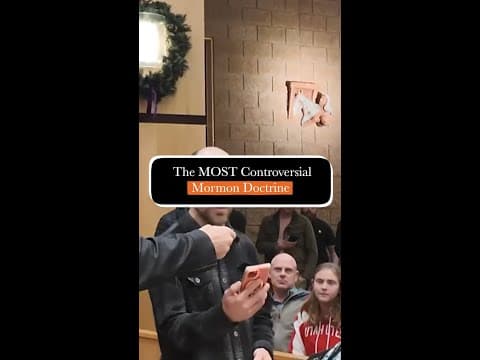
The Abomination of Diminished Divinity
Jacob Chapman’s succinct analysis of the First Vision’s warning against creeds cuts to the heart of a critical Latter-day Saint distinction: our radical claim of divine parentage versus the creedal tradition’s depiction of humanity as mere creatures. This isn't a condemnation of individuals, but a recognition of a theological error with profound consequences.

The Lord’s pronouncements, delivered through Joseph Smith, are not always comfortable. They demand rigorous self-examination and a willingness to challenge deeply ingrained assumptions. The declaration that existing creeds were an “abomination” in His sight is one such challenge, often met with defensive explanations or dismissals. But to brush it aside as a historical peculiarity is to miss the profound theological truth embedded within it. As Jacob Chapman so boldly articulates in the linked discussion, the issue isn’t about labeling those who hold to these creeds as corrupt; it’s about the doctrine those creeds espouse.
Many Latter-day Saints, even those unfamiliar with the nuances of theological history, feel a subtle but persistent unease when encountering the Apostles’ Creed or the Nicene Creed. Why? It’s not necessarily a conscious rejection of every tenet—Chapman himself admits agreement with 95%—but a visceral sense that something is fundamentally *off*. The point of contention, he argues, resides in the phrase “consubstantial with the Father,” and its implications regarding our relationship to God.
This seemingly minor phrasing, born of centuries of philosophical debate and theological maneuvering, establishes a hierarchical distance between God and humanity. It subtly relegates us to the status of *creatures*, distinct from and inferior to the divine. This is a stark contrast to the radical claim at the heart of the Restoration: that each of us is a child of God, a joint heir with Christ, capable of sitting with Him on His throne (Revelation 3:21). As Elder Bruce R. McConkie taught, “All men are sons of God, and therefore possess divine natures, which is the very nature of Christ” (Mormon Doctrine, 203).
The insidious nature of this doctrinal shift lies in its capacity to subtly diminish our self-perception and, consequently, our understanding of God. If we are merely creatures, our potential is limited, our connection to the divine is tenuous, and our relationship to God is one of subservience rather than kinship. This undermines the very essence of the gospel message—the promise of exaltation, of becoming like our Father in Heaven.
Think of the implications for temple covenants, for priesthood authority, for the pursuit of personal revelation. How can we earnestly seek to become like God if we fundamentally believe ourselves to be separate from Him? The iron rod, that symbol of unwavering faith and connection to the fountain of living waters (D&C 49:16), becomes brittle and breaks when our understanding of our divine heritage is compromised.
The Brethren have consistently emphasized the importance of understanding our identity as children of God. President Howard W. Hunter declared, “We are not merely creatures; we are children of God, inheritors of His attributes, and recipients of His love.” To deny this fundamental truth is to invite spiritual darkness and to sever ourselves from the source of all truth and light.
This is not about condemning those who hold to different beliefs; it is about recognizing the subtle but pervasive influence of doctrines that diminish our understanding of our divine potential. It is a call to reclaim the radical truth of the Restoration—that we are children of God, heirs to His kingdom, and destined to become like Him.
Let us, as disciples of Christ, strive to understand and embody this profound truth, and let it guide our actions, our relationships, and our pursuit of eternal life.
Frequently Asked Questions
Loading comments...
Related Posts
The Eternal Blueprint: Gender, Identity, and the Plan of Salvation

The Rod and the Savior: Finding Christ in the Crucible


From Survival Identity to Covenant Identity: Following the Pattern of Abraham
