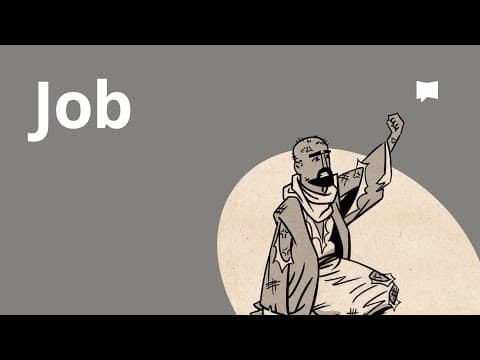
The Silence of God: Job and the Iron Rod of Understanding
Job’s story isn’t about *why* suffering exists, but about the nature of faith and the limits of human comprehension in the face of divine mystery. It's a crucible for the soul, demanding a posture of humility and a willingness to trust even when answers remain veiled.

We often approach scripture with a desire for neat explanations, for tidy answers to the weighty questions that press upon our hearts. We want to understand the why. But what if the scriptures aren’t always meant to be understood in that way? What if, instead, they are designed to refine, to test, and ultimately, to draw us closer to the source of truth, even when that truth remains shrouded in seeming paradox?
The Book of Job, as presented in the recent BibleProject video, exemplifies this principle beautifully.
The deliberate ambiguity surrounding Job’s narrative – his location, his era, even his ethnicity – immediately signals that this is not a historical account intended for straightforward parsing. Rather, it’s a theological drama, a cosmic courtroom scene where the question isn’t *why* Job suffers, but what that suffering reveals about the nature of righteousness, faith, and the inscrutable wisdom of God. The Spirit testifies of this; the pursuit of a historical Job diminishes the profound lesson contained within.
The Court of Heaven and the Devil's Accusation
The initial portrayal of the heavenly council, with Satan’s challenge to God’s assessment of Job’s righteousness, is stark and unsettling. Satan's assertion – that Job’s piety is merely transactional, a product of divine blessing – strikes at the very heart of what it means to be a Latter-day Saint. Is our devotion born of gratitude and obedience, or are we simply reacting to circumstance? The Brethren have consistently warned against a covenant built on ease and prosperity (see M. Nolan Robinson, “The Covenant Path”). Job's trial reveals the danger of such a superficial foundation.
Beyond Explanation: The Run of Poetry and Divine Response
The dialogues between Job and his “friends” – Eliphaz, Bildad, and Zophar – are a testament to the inadequacy of human reasoning in the face of profound suffering. Their attempts to offer explanations, rooted in a simplistic understanding of divine justice, ultimately fail to comfort Job. It is in the subsequent poetic pronouncements of God, a whirlwind of divine power and incomprehensible vastness, that the true lesson emerges.
God doesn’t answer why. He doesn’t offer a justification for Job’s pain. Instead, he reveals the sheer immensity of His creation, the intricate tapestry of the cosmos, and the limitations of human understanding. This is the iron rod, brother and sister: a humbling realization that our minds, finite as they are, cannot fully grasp the divine purpose. To demand an explanation is to presume a level of comprehension that we do not possess. It is to grasp at the iron rod and attempt to pull it down, rather than allowing it to guide us.
The Invitation to Faith
Job’s ultimate restoration—his renewed wealth and family—is not the point. The point is his submission to God, a recognition of the divine prerogative to act beyond human comprehension. As Job himself declares, “Know now that God doeth all these things, that I may see his work: which I did not search, nor did I understand. Yea, I have heard of thee by the hearing of the ear: but now mine eye seeth thee.” (Job 42:5).
The Book of Job is a powerful reminder that true faith is not rooted in certainty, but in trust. It’s a call to relinquish our need for answers and embrace the mystery of God’s plan, even when – especially when – that plan is shrouded in darkness. It is a lesson echoed in the words of the Prophet Joseph Smith: “It is better to believe than to doubt.” (History of the Church, 6:302).
Let us ponder Job’s experience, not with a desire to dissect and analyze, but with a yearning to deepen our own faith and to cultivate a humble reverence for the incomprehensible wisdom of the Lord.
Frequently Asked Questions
Loading comments...
Related Posts
The Weight of Time, the Refinement of Suffering: Job and the Iron Rod


The Temple's Whisper: Obedience and the Balm of Suffering


The Wisdom Literature: A Foundation for Discernment
